
I am a professor at the College of Computer Science, Chongqing University, Chongqing, China. I received the B.S. and Ph.D. degrees in Control Science and Engineering from Tsinghua University, Beijing, China, in 2010 and 2016 respectively. Currently, I am doing the Marie Sklodowska-Curie Fellow with the University of Exeter, Exeter, United Kingdom, under the project “KEEN: Knowledge-Driven Explainable Misinformation Detection for Trustworthy Computational Social Systems”. I have published 90+ high quality journal and conference articles, including TKDE, TNNLS, TITS, TETC, TCSS, PR, DASFAA, HPCA, DAC, DATE, etc. These publications have generated 1600+ citations in Google scholar. I serve as a reviewer for several top journals and conferences, including TPAMI, TKDE, TCAD, TNNLS, TITS, KDD, AAAI, etc. I have served as a sension/workshop chair and TPC member for several prestigious conferences, including WASA’2017, HHME’2020, ICC’2019, DSONAM’2020, etc.

My research interest includes:
- Industrial Big Data Analytics
- Social Network Analysis
- Data Mining
- Machine Learning
- Explainable AI
- Graph Neural Networks
- Flight Data Analysis
📢 Updates
- [2026.05] One paper on fake news detection was accepted by TKDE (JCR Q1, IF=10.4)
- [2026.03] One paper on fake news detection was accepted by TKDE (JCR Q1, IF=10.4)
- [2025.12] One paper on flight data anlysis was accepted by IEEE Sensors Journal (JCR Q1)
- [2025.11] One paper on flight data anlysis was accepted by TITS (JCR Q1, IF=8.4)
- [2025.11] One paper on dynamic network modeling was published in Physical Review E: Letters
- [2025.10] One paper on fake news detection was accepted by WSDM 2026 (CCF-B, Acceptance Rate: 16.3%)
- [2025.07] One paper on information popularity prediction was accepted by TKDE (JCR Q1, IF=10.4)
- [2025.06] One paper on information diffusion prediction was accepted by Knowledge-Based Systems (JCR Q1, IF=7.6)
- [2025.05] One paper on flight data anlysis was accepted by TITS (JCR Q1, IF=8.4)
- [2025.04] One paper on flight data analysis was accepted by EAAI (JCR Q1, IF=8.0)
- [2025.03] One paper on aspect sentiment triplet extraction was accepted by Data Science and Engineering (JCR Q1, IF=4.6)
- [2025.02] One paper on wargame data mining was accepted by Acta Automatica Sinica (自动化学报, CCF-A类中文期刊)
💼 Employment
- 2023.09 - now,
 Professor, College of Computer Science, Chongqing University, Chongqing China.
 - 2024.06 - 2026.05,
 Marie Curie Fellow, Department of Computer Science, University of Exeter, U.K.
 - 2018.09 - 2023.08, Associate Professor, College of Computer Science, Chongqing University, Chongqing China.
- 2016.02 - 2018.08, Lecturer, College of Computer Science, Chongqing University, Chongqing China.
- 2014.09 - 2015.01,
 Research Assistant, Department of Information Systems, City University of Hong Kong, Hong Kong China.
🎓 Educations
- 2010.09 - 2016.01,
 PhD Degree, Control Science and Engineering, Tsinghua University, Beijing China.
 - 2006.09 - 2010.07, Bachelor Degree, Department of Automation, Tsinghua University, Beijing China.
📝 Selected Publications
English (*Corresponding author)
- Jiongbiao Cai,
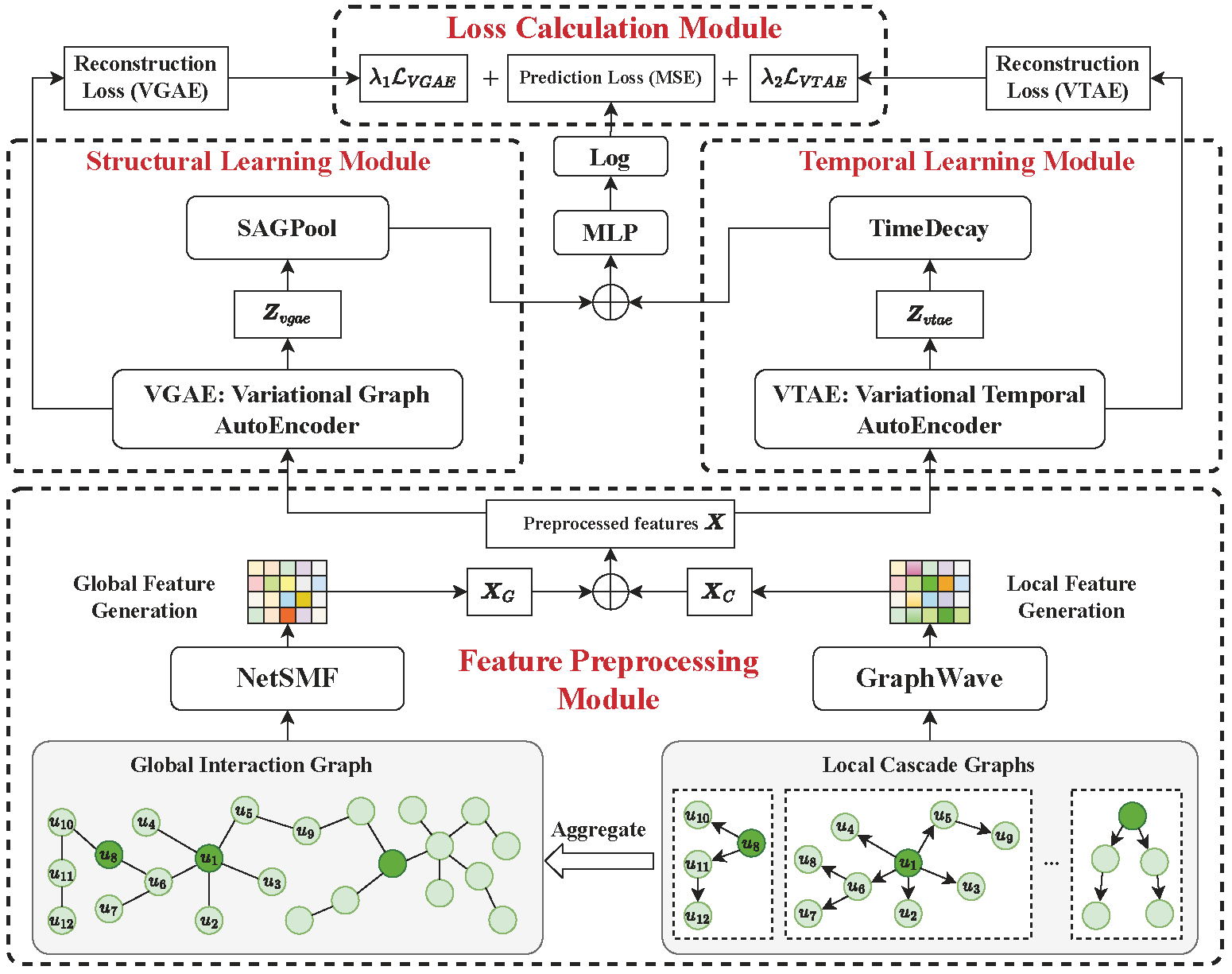
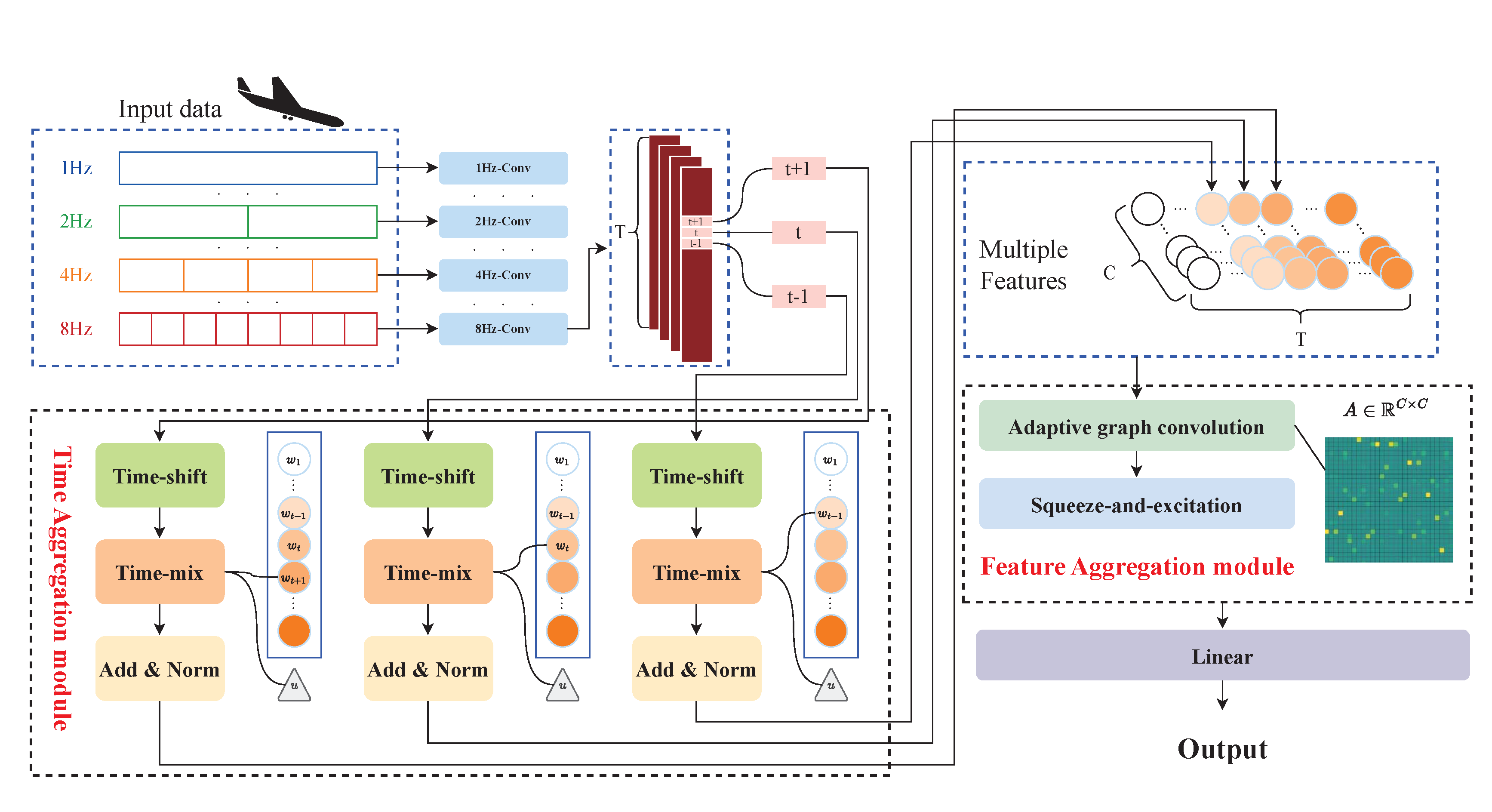
Jiaxing Shang*, Xu Li, Chengxiang Li, Linjiang Zheng. Fine-Grained Time and Hidden Feature Learning for Interpretable Hard Landing Prediction Based on QAR Data. IEEE Transactions on Intelligent Transportation Systems. 2025. (JCR Q1; IF=8.4)
[HTML]
-
Xinyuan Zhu, Fei Hao*, Ming Lei, Aziz Nasridinov,
Jiaxing Shang, Zhengxin Yu, Longjiang Guo. Future Generation Computer Systems. 2026, 175: 108033. (JCR Q1; IF=6.1)
[HTML] -
Jiaxing Shang*, Xiaoquan Li, Ruixiang Zhang, Linjiang Zheng, Xu Li, Riquan Zhang, Xinbin Zhao, Fan Li, Hong Sun. A Dual Two-Stage Attention-based Model for Interpretable Hard Landing Prediction from Flight Data. Engineering Applications of Artificial Intelligence. 2025,154(15): 110911. (JCR Q1; IF=8.0)
[HTML] [Code] -
Jiaxing Shang*, Yuxuan Zhang, Linyang Zhong, Ruiyuan Li. Syntactic-Enhanced Multi-Task Learning Model for Aspect Sentiment Triplet Extraction. Data Science and Engineering. 2025. (JCR Q1; IF=4.6)
[HTML] -
Lei Song, Xu Li, Hongtao Liu, Lin Wu, Hong Sun, Linjiang Zheng*,
Jiaxing Shang*. MDGNN: Multiple Flight Safety Incidents Prediction Model Based on Dynamic Graph Neural Networks. IEEE Transactions on Intelligent Transportation Systems. 2025, 26(4): 5598-5612. (JCR Q1; IF=8.4)
[HTML] -
Longquan Liao, Linjiang Zheng*,
Jiaxing Shang, Xu Li, Fengwen Chen. ATPF: An Adaptive Temporal Perturbation Framework for Adversarial Attacks on Temporal Knowledge Graph. IEEE Transactions on Knowledge and Data Engineering. 2025, 37(3): 1091-1104. (JCR Q1; IF=10.4)
[HTML] -
Xiaojuan Yang,
Jiaxing Shang*, Qinghong Hu, Dajiang Liu. ARIS: Efficient admitted influence maximizing in large-scale networks based on valid path reverse influence sampling. IEEE Transactions on Emerging Topics in Computing. 2024, 12(3): 700-714. (JCR Q1; IF=5.4)
[HTML] -
Yincheng Han, Dajiang Liu,
Jiaxing Shang*, Linjiang Zheng, Jiang Zhong, Weiwei Cao, Hong Sun, Wu Xie. BALQUE: Batch active learning by querying unstable examples with calibrated confidence. Pattern Recognition. 2024, 151: 110385. (JCR Q1; IF=7.6)
[HTML] [Code] -
Dajiang Liu*, Decai Pan, Xiao Xiong,
Jiaxing Shang, Shouyi Yin. PMP: Pattern Morphing-based Memory Partitioning in High-Level Synthesis. Proceedings of the 61st ACM/IEEE Design Automation Conference. 2024. [HTML] -
Hong Yin, Jiang Zhong*, Rongzhen Li,
Jiaxing Shang, Chen Wang, Xue Li. High-order neighbors aware representation learning for knowledge graph completion. IEEE Transactions on Neural Networks and Learning Systems. 2024, 36(3): 5273-5287. (JCR Q1, IF=8.9) [HTML] -
Xu Li,
Jiaxing Shang*, Linjiang Zheng*, Qixing Wang, Dajiang Liu, Xiaodong Liu, Fan Li, Weiwei Cao, Hong Sun. IMTCN: An Interpretable Flight Safety Analysis and Prediction Model Based on Multi-Scale Temporal Convolutional Networks. IEEE Transactions on Intelligent Transportation Systems. 2024, 25(1): 289-302. (JCR Q1, IF=8.4) [HTML] -
Mengya Guan, Xinjun Cai,
Jiaxing Shang*, Fei Hao, Dajiang Liu, Xianlong Jiao, Wancheng Ni. HMSG: Heterogeneous graph neural network based on metapath subgraph learning. Knowledge-Based Systems. 2023, 279: 110930. (JCR Q1; IF=7.6)
[HTML] [Code] -
Haodong Chen,
Jiaxing Shang*, Linjiang Zheng*, Xu Li, Xiaodong Liu, Hong Sun, Xinbin Zhao, Liling Yu. SDTAN: Scalable Deep Time-Aware Attention Network for Interpretable Hard Landing Prediction. IEEE Transactions on Intelligent Transportation Systems. 2023, 24(9): 10211-10223. (JCR Q1; IF=8.4)
[HTML] -
Xueqi Jia,
Jiaxing Shang*, Dajiang Liu, Haidong Zhang, Wancheng Ni*. HeDAN: Heterogeneous diffusion attention network for popularity prediction of online content. Knowledge-Based Systems. 2022, 254: 109659. (JCR Q1; IF=7.6)
[HTML] -
Ziwei Jin,
Jiaxing Shang*, Wancheng Ni*, Liang Zhao, Dajiang Liu, Baohua Qiang, Wu Xie, Geyong Min. IM2Vec: Representation learning-based preference maximization in geo-social networks. Information Sciences. 2022, 604: 170-196. (JCR Q1; IF=6.8)
[HTML] -
Xu Li,
Jiaxing Shang*, Linjiang Zheng*, Qixing Wang, Hong Sun, Lin Qi. Curvecluster+: Curve clustering for hard landing pattern recognition and risk evaluation based on flight data. IEEE Transactions on Intelligent Transportation Systems. 2022, 23(8): 12811-12821. (JCR Q1; IF=8.4)
[HTML] -
Xianren Zhang,
Jiaxing Shang*, Xueqi Jia, Dajiang Liu, Fei Hao, Zhiqing Zhang. CollaborateCas: popularity prediction of information cascades based on collaborative graph attention networks. International Conference on Database Systems for Advanced Applications. 2022, 714-721.
[HTML] -
Jiaxing Shang*, Shangbo Zhou, Xin Li, Lianchen Liu, Hongchun Wu. CoFIM: A community-based framework for influence maximization on large-scale networks. Knowledge-Based Systems. 2017, 117: 88-100. (JCR Q1, IF=7.6)
[HTML] [Code]
Chinese
-
陈露,
尚家兴*, 刘大江, 张玉芳, 倪晚成. 基于异构图神经网络的可解释兵棋态势预测方法. 自动化学报. 2025, 51(6): 1248-1260. (CCF-A)
[HTML] -
潘德财, 牟迪,
尚家兴, 刘大江*. 基于访存图案变形的CGRA存储划分优化. 计算机研究与发展. 2025, 62(4): 1003-1016. (CCF-A)
[HTML] -
冯永*, 张春平, 强保华, 张逸扬,
尚家兴. GP-WIRGAN: 梯度惩罚优化的Wasserstein图像循环生成对抗网络模型. 计算机学报. 2020, 2: 190-205. (CCF-A)
[HTML] [PDF] -
冯永*, 张备, 强保华, 张逸扬,
尚家兴. MN-HDRM:长短兴趣多神经网络混合动态推荐模型. 计算机学报. 2019, 1: 16-28. (CCF-A)
[HTML] [PDF]
🏅 Honors and Awards
- 2023.02 Marie Sklodowska-Curie Postdoctoral Fellowship (Acceptance rate: 17.53%)
- 2022.09 Outstanding Young Teacher Award, Chongqing University
- 2021 IEEE Outstanding Service Award as Invited Talk Speaker of the 20th IEEE International Conference on Trust, Security and Privacy in Computing and Communications (TrustCom’2021).
- 2021 IEEE Outstanding Service Award as Workshop Chair of the 15th IEEE International Conference on Big Data Science and Engineering (BigDataSE’2021).
- 2021 IEEE Outstanding Service Award as Workshop Chair of the 3rd International Workshop on Machine Learning assisted Smart System (MLSys’2021).
- 2021 IEEE Outstanding Service Award as General Chair of the 4th International Workshop on Next Generation Data-driven Networks (NGDN’2021).
- 2020 IEEE Outstanding Service Award as Workshop Chair of the 1st International Workshop on Data-driven Social Network Analysis and Mining: Algorithms and Applications (DSONAM’2020).
- 2019 IEEE Outstanding Service Award as Workshop Chair of the 2nd International Workshop on Next Generation Data-driven Networks (NGDN’2019).
🏛️ Conferences
- 2022.10, The 18th EAI International Conference on Collaborative Computing: Networking, Applications and Worksharing (CollaborateCom 2022), Oral.
- 2022.08, International Conference on Knowledge Science, Engineering and Management (KSEM 2022), Oral.
- 2022.07, The 34th International Conference on Software Engineering and Knowledge Engineering (SEKE 2022), Oral.
- 2022.04, International Conference on Database Systems for Advanced Applications (DASFAA 2022), Oral.
- 2021.10, The 20th IEEE International Conference on Trust, Security and Privacy in Computing and Communications (TrustCom’2021), Invited Talk.
- 2021.06, 2021 22nd IEEE International Conference on Mobile Data Management (MDM), Oral.
- 2020.10, The 21st International Conference on Web Information Systems Engineering (WISE 2020), Oral.
- 2018.12, The 25th International Conference on Neural Information Processing (ICONIP 2018), Oral.
- 2017.11, The 24th International Conference on Neural Information Processing (ICONIP 2017), Oral.
- 2017.06, The 12th International Conference on Wireless Algorithms, Systems, and Applications (WASA 2017), Oral.
💻 KEEN Project
Project Name:
KEEN: Knowledge-Driven Explainable Misinformation Detection for Trustworthy Computational Social Systems
Project Updates:
- [2025.10] Jingqing Wang,
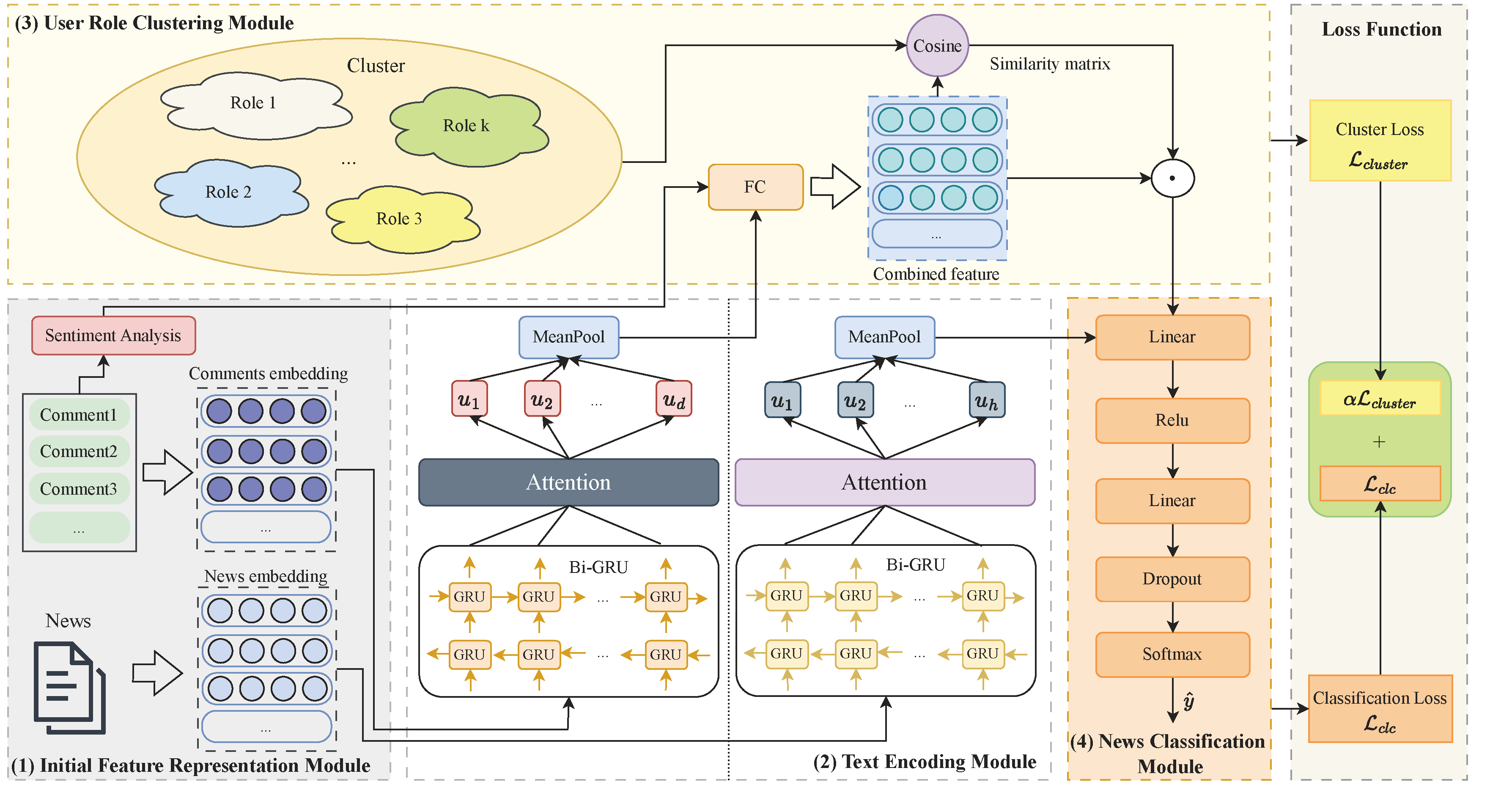
Jiaxing Shang*, Rong Xu, Fei Hao, Tianjin Huang, Geyong Min. SARC: Sentiment-Augmented Deep Role Clustering for Fake News Detection. The 19th ACM International Conference on Web Search and Data Mining (WSDM). 2026. (Acceptance Rate: 16.3%) [HTML] [Code]
Fake news detection has been a long-standing research focus in social networks. Recent studies suggest that incorporating sentiment information from both news content and user comments can enhance detection performance. However, existing approaches typically treat sentiment features as auxiliary signals, overlooking role differentiation, that is, the same sentiment polarity may originate from users with distinct roles, thereby limiting their ability to capture nuanced patterns for effective detection. To address this issue, we propose SARC, a Sentiment-Augmented Role Clustering framework which utilizes sentiment-enhanced deep clustering to identify user roles for improved fake news detection. The framework first generates user features through joint comment text representation (with BiGRU and Attention mechanism) and sentiment encoding. It then constructs a differentiable deep clustering module to automatically categorize user roles. Finally, unlike existing approaches which take fake news label as the unique supervision signal, we propose a joint optimization objective integrating role clustering and fake news detection to further improve the model performance. Experimental results on two benchmark datasets, RumourEval-19 and Weibo-comp, demonstrate that SARC achieves superior performance across all metrics compared to baseline models. The code is available at: https://anonymous.4open.science/r/SARC-5AEA.
- [2025.06] Haoyu Xiong,
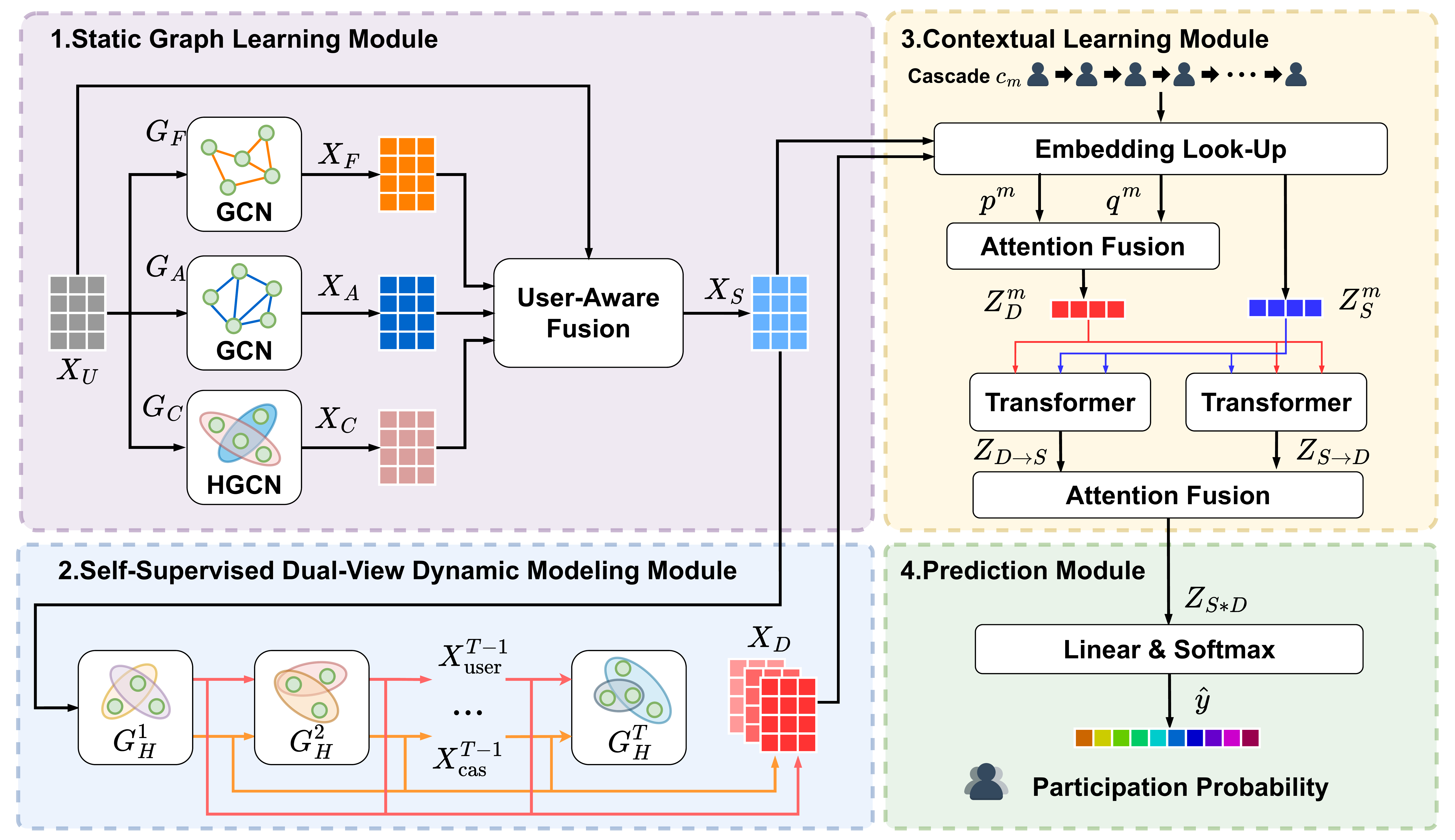
Jiaxing Shang*, Fei Hao, Dajiang Liu, Geyong Min. SDVD: Self-supervised dual-view modeling of user and cascade dynamics for information diffusion prediction. Knowledge-Based Systems. 2025, 326(27): 114005. (JCR Q1; IF=7.6) [HTML] [Code]
In this paper, we propose SDVD, a novel framework for Self-supervised Dual-View modeling of user and cascade Dynamics for information diffusion prediction. SDVD first constructs two auxiliary graphs from historical data: an adjacency dependency graph to capture temporal dependencies and a hypergraph to model group interactions. It then leverages graph neural networks and hypergraph neural networks to extract structural features from the graphs. Furthermore, we design a self-supervised dual-view dynamic modeling module to learn temporal variations in diffusion patterns from both user and cascade perspectives, followed by a cross-attention mechanism to combine these information. Experiments on four real-world datasets show that SDVD achieves statistically significant improvements (p<0.05), with up to a 6.63% increase in MAP@10.
- [2025.04] Rong Xu,
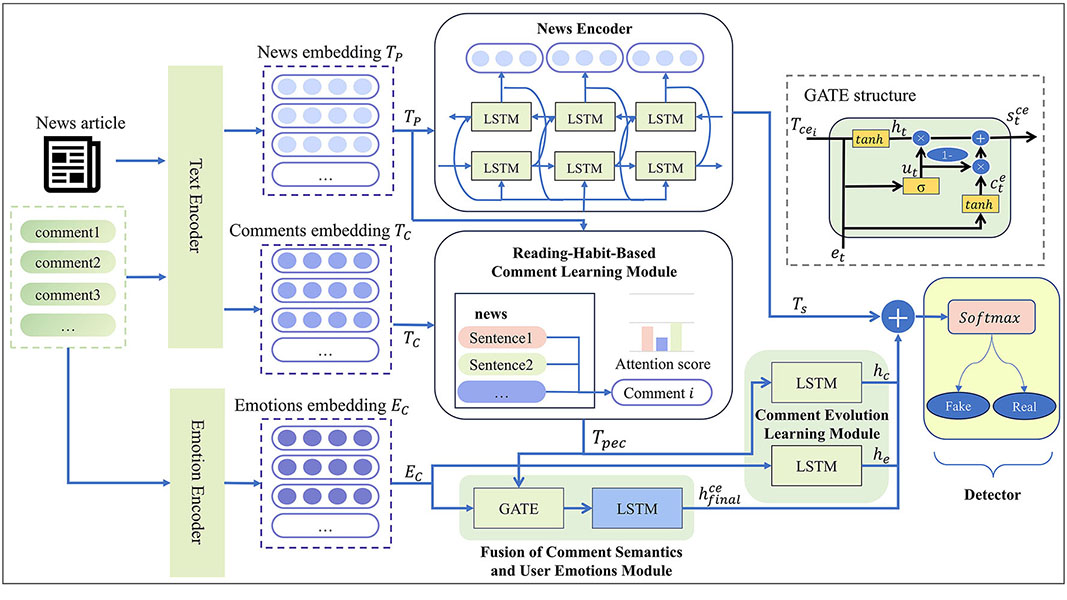
Jiaxing Shang*, Mengya Guan, Jingqing Wang, Haoyue Cui, Geyong Min. MESE: Mining Emotional and Semantic Evolution from User Comments for Fake News Detection. IEEE Transactions on Knowledge and Data Engineering. 2026, 38(7): 4528-4541. (JCR Q1; IF=10.4)
In this paper, to address fake news detection issue, we comprehensively consider three key factors within the comment section: emotional evolution, semantic evolution, and diversity of user attention, and propose a novel fake model MESE by mining the emotional and semantic evolution from user comments. Specifically, we first propose a habit-aware comment representation learning method to obtain news-enhanced personalized comment representations. Next, a gating mechanism is introduced to deeply integrate emotional and semantic features. Additionally, we develop a comment emotional and semantic evolution module to capture shifts in public reactions over time. Finally, these diverse representations are fused to generate prediction results. Extensive experiments on two public datasets demonstrate the superior performance of MESE.
- [2025.02] Yincheng Han,
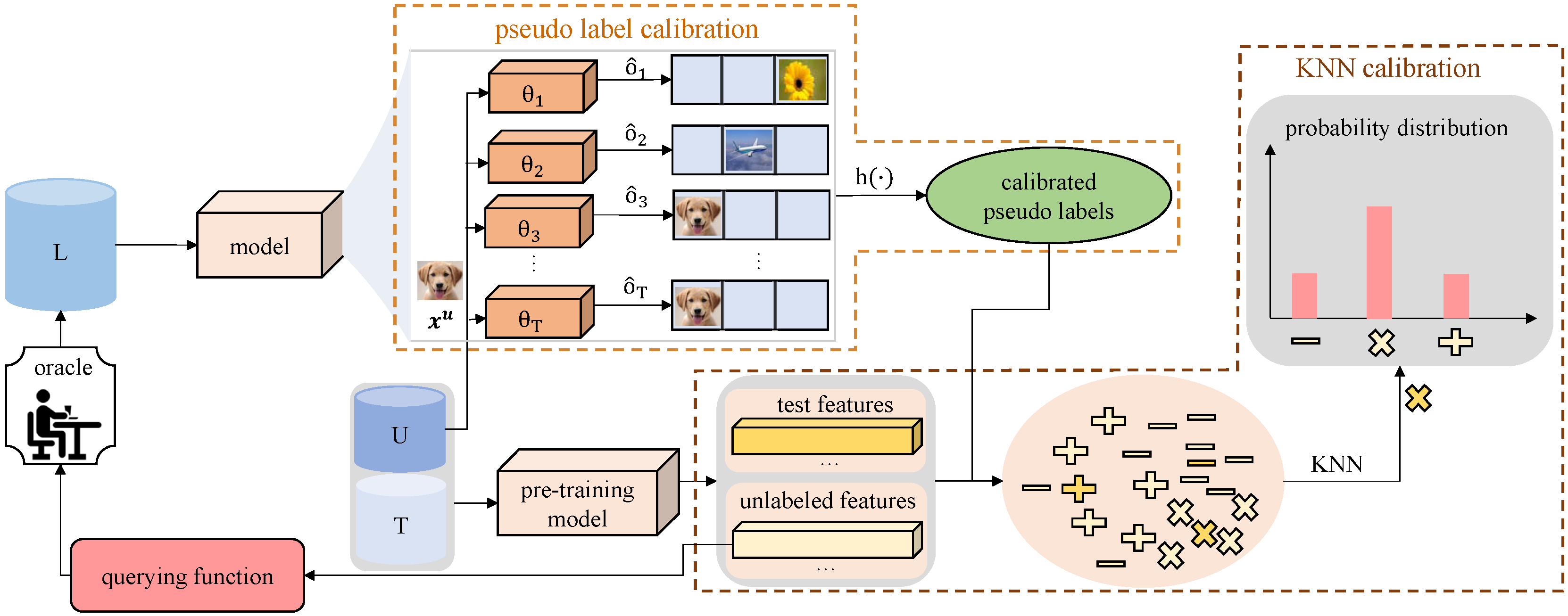
Jiaxing Shang*, Ruiyuan Li, Xu Li, Longquan Liao, Linjiang Zheng, Geyong Min. Boosting Low-budget Active Learning with Label Calibration and Unsupervised Representations. IEEE Transactions on Pattern Analysis and Machine Intelligence. 2025. (JCR Q1; IF=18.6, submitted)
In active learning research, low-budget active learning poses a significant challenge. To address this challenge, we propose a novel and unified framework that leverages label calibration and unsupervised representations. Specifically, to cope with the scarcity of labeled data, we perform pre-training on the entire unlabeled dataset to generate unsupervised representations. To address model instability, we creatively calibrate pseudo-labels of unlabeled examples using statistical information derived from model outputs during training. These calibrated pseudo-labels and unsupervised representations are fed into a KNN classification model to generate predictions for test examples. Theoretical and empirical experiments demonstrate its superior effectiveness in boosting the performance of active learning algorithms under low-budget constraints.
- [2024.06] Mengya Guan,
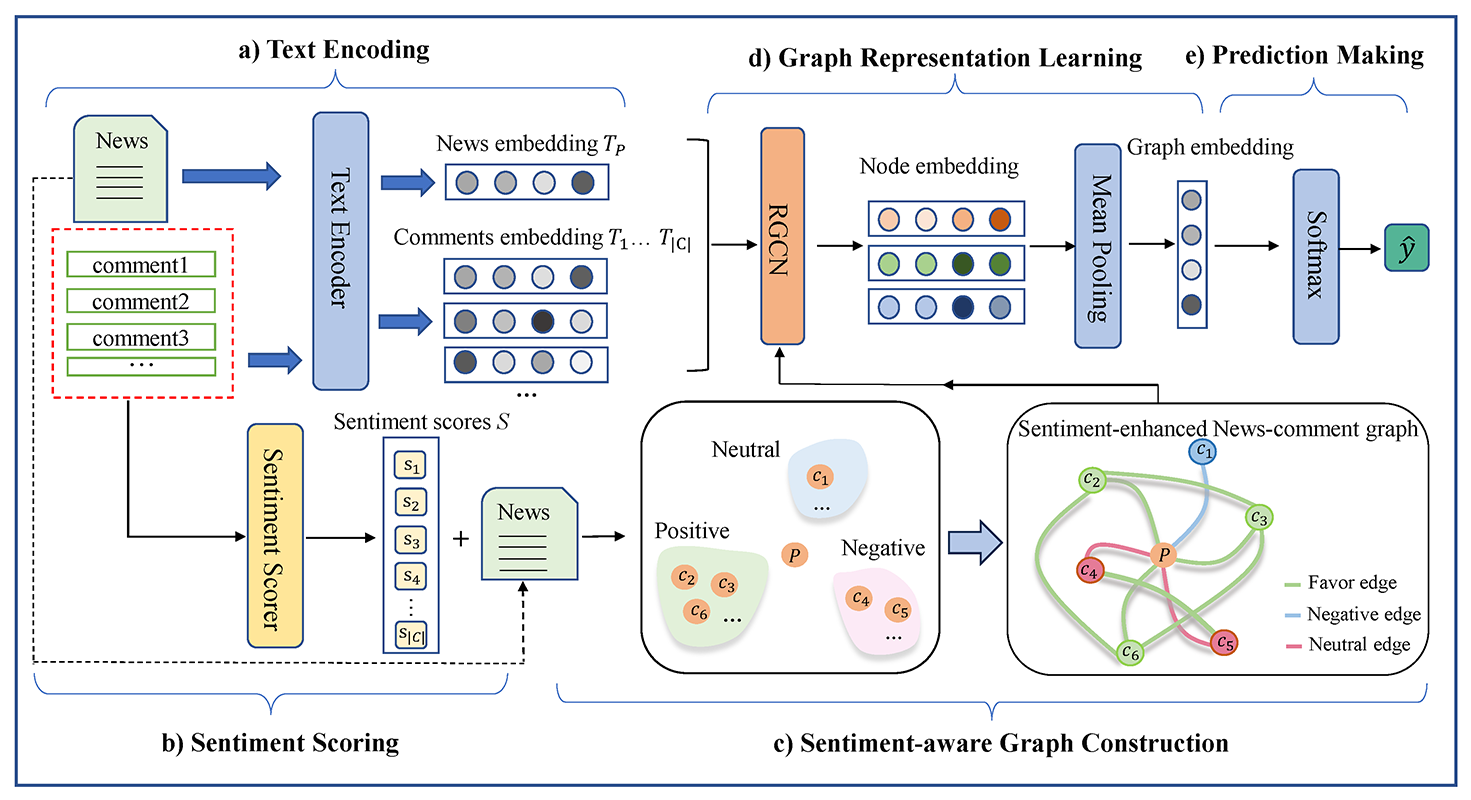
Jiaxing Shang*, Rong Xu, Fei Hao, Ruiyuan Li, Geyong Min. ReFEND: Leveraging Social Sentiment Resonances for Fake News Detection. IEEE Transactions on Knowledge and Data Engineering. 2026, 38(5): 3052-3064. (JCR Q1; IF=10.4, accepted)
In this paper, we propose a novel framework named ReFEND, which leverages the sentiment resonances among the social users (i.e., social sentiment resonances) and the sentiment relationship between news content and user comments to improve the fake news detection performance. Specifically, we first utilize sentiment scorers to assess the sentiment of comments and identify users’ emotional tendencies. Then we creatively construct a sentiment-aware multi-relational graph to capture social sentiment resonances. Next, we leverage the relational graph convolutional network (RGCN) to learn the interactions on sentiment-aware graph. Experimental results on three datasets indicate that ReFEND significantly outperforms the state-of-the-art sentiment-based methods.